Start here · Chapter 2 of 69
History of Kiro
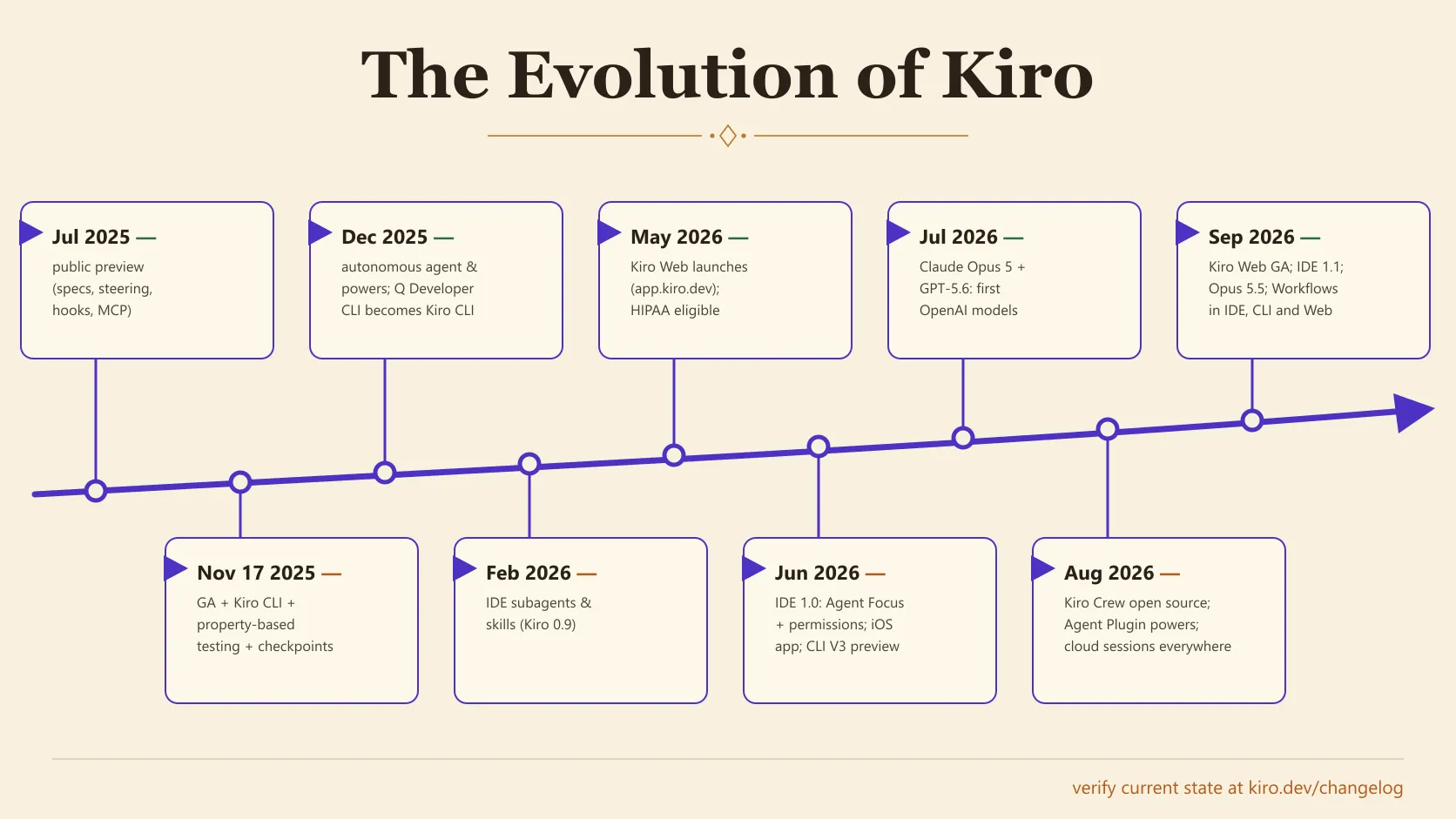
Kiro's timeline: the July 2025 preview, November 2025 GA, IDE 1.0, Kiro Web GA, Kiro Crew, and how Amazon Q Developer CLI became Kiro CLI.
Beginner friendly 12 min read last reviewed 2026-10-21
◎ Learning objective
Trace Kiro's major milestones from preview to today, and explain how Amazon Q Developer CLI relates to Kiro CLI.
Kiro went from a surprise AWS preview in July 2025 to a five-surface platform in about fourteen months. This chapter is the dated timeline, so you can tell at a glance whether a tutorial you found is describing today’s Kiro or a version two rewrites ago.
Why a history chapter at all?
Two practical reasons. First, you will meet older tutorials and videos that show different commands, names, or pricing. Knowing the timeline tells you instantly whether advice is outdated. Second, Kiro’s story explains its shape: it merged a popular terminal tool (Amazon Q Developer CLI) with a new spec-driven IDE, which is why the same core concepts appear in both places today.
Timeline
July 14-15, 2025: Public preview. AWS unveiled Kiro at its New York Summit as an agentic IDE built on Code OSS (the open-source foundation of VS Code). It launched with the ideas that still define it: specs, steering, hooks, and MCP support. It was introduced by AWS leaders Nikhil Swaminathan and Deepak Singh.
Late July to August 2025: The waitlist era. Demand exceeded the capacity AWS had provisioned. Within weeks there was a waitlist and daily usage limits, an unusually loud start for a developer tool preview.
November 17, 2025: General availability. The big one. Alongside GA (after 250,000+ preview users), AWS shipped:
- Kiro CLI, announced as “Bring Kiro agents to your terminal”
- Property-based testing: automated checks that your code actually matches your spec
- Checkpointing: restore points so agent work can be rolled back confidently
- Team plans: centralized billing and management
November 24, 2025: Claude Opus 4.5 became available as a model option.
December 2, 2025: the Kiro autonomous agent was introduced.
December 3, 2025: Powers arrived: one-click installable bundles (POWER.md + MCP tools + steering) that teach the agent a specific technology, with launch partners like Stripe, Supabase, Figma, and Datadog.
Late 2025: Q Developer CLI becomes Kiro CLI. Kiro CLI itself debuted at GA (v1.20.0, November 17, 2025) as the official successor to Amazon Q Developer CLI, and existing Q Developer CLI installations were rebranded and upgraded to Kiro CLI in the weeks that followed (more below).
2026: The platform fills out.
- February 5, 2026: Kiro 0.9 brought custom subagents to the IDE, agent skills (following the open agentskills.io standard), enterprise controls, granular code review, and smart refactoring tools.
- February 13, 2026: Claude Sonnet 4.6 joined the model lineup (now with a 1M-token context). Through spring 2026 the Claude line in Kiro kept growing; by mid-year it spanned Sonnet 4.0/4.5/4.6 and Opus 4.5/4.6/4.7.
- May 18, 2026: Kiro Web launched at app.kiro.dev: cloud agents that work on your GitHub repositories from the browser.
- May 26, 2026: Kiro became a HIPAA-eligible service (IDE and CLI).
- May 29, 2026: Claude Opus 4.8 (1M-token context) joined the model lineup; CLI v2.5 added visible thinking and subagent review loops.
- June 2026: a busy month. Kiro Web gained GitLab support, browser-based specs, and Automations (scheduled recurring tasks that run and open pull requests on a cron). CLI v2.6 added transcript export and persistent model preferences, and CLI V3 early access (v2.8.0, June 17) introduced a unified agent harness shared across the IDE, Web, and CLI, opt-in with
kiro-cli --v3. At AWS Summit NYC on June 17, a native iOS app was announced in gated preview, letting developers start sessions, review diffs, and approve changes from their phones. - June 25, 2026: Kiro IDE 1.0. The 1.0 release added Agent Focus (an experimental chat-first view that runs several agents in parallel), a capability-based permissions system (every file read, command, and MCP call checked against your rules), Markdown-based custom agents, natural-language hook generation, and dockable chat tabs. CLI v2.10.0 (June 26) followed with configuration hot-reload for agent and MCP settings.
- July 1, 2026: Claude Sonnet 5 became available across the IDE, CLI, and Web (1M-token context).
- July 14, 2026: OpenAI GPT-5.6 arrived, the first non-Anthropic models in Kiro: three tiers called Sol (flagship), Terra (balanced), and Luna (fastest). Kiro is no longer a single-vendor platform.
- July 24, 2026: Claude Opus 5 became available (1M context, 2.2x), strongest on long-running agentic tasks and multi-agent coordination.
- Late July 2026: a stream of IDE and CLI updates. The IDE gained global hooks (user-level, applying across all workspaces), a searchable session history panel, and an “Ask Kiro to Fix” quick action in the editor context menu. The CLI added
/tangentfor branching into side-conversations,/upgrade-agentto migrate V2 custom agent configs to the V3 format, and MCP authentication management commands. - August 4, 2026: Kiro Crew is open-sourced. AWS published Kiro Crew under the Apache 2.0 licence: an always-on personal agent that runs on your own hardware, locally or on a remote host, with subagents, scheduling, memory, and connections to Slack, Discord, Telegram, and more. It picked up coverage from InfoQ, InfoWorld, Forbes, and DevOps.com, and it made Kiro a five-surface product rather than a four-surface one.
- August 7, 2026: IDE v1.0.288. Powers are now packaged in the open Agent Plugin format, installable from local folders or GitHub URLs. Agent Focus Mode gained session pinning and Kiro CLI hand-off.
- August 11-12, 2026: cloud sessions reach the IDE and CLI. The managed AWS sandbox that had been powering Kiro Web and the iOS app opened up to the desktop tools: CLI v2.17.0 added
kiro-cli --cloudwith resume-from-anywhere, and IDE v1.0.293 put Cloud Sessions inside Agent Focus Mode as a preview. CLI v2.18.0 followed the next day with/voicedictation (transcribed on-device with Whisper), a spec review screen for staging line comments, and an enterprise opt-in switch for cloud sessions. - August 12-13, 2026:
AGENTS.mdbecomes steering. CLI v2.18.0 and IDE v1.0.309 began loadingAGENTS.mdfiles as steering context from anywhere in the workspace tree. It is a quiet but telling change: Kiro now reads the cross-tool instruction file that several competing agents also honor, instead of only its own.kiro/steering/format. - August 17, 2026: Kiro Web gains enterprise sign-in. Teams can reach Kiro Web through Okta or Microsoft Entra ID, on Pro and above.
- August 18-19, 2026: reliability work. IDE v1.0.337 kept ignored files out of search results and tightened filesystem and command permission rules. CLI v2.19.0 added automatic recovery from stream failures - an idle watchdog, retries for throttling and dropped connections, and a 60-minute streaming timeout - the kind of change that only matters once agents routinely run for hours.
- August 26-27, 2026: polish on both desktop surfaces. CLI v2.20.0 gave V3 spec runs a full-screen task execution view (
/spec run), with the task scope chosen before execution and progress shown live. IDE v1.0.395 made third-party extensions work alongside Kiro, adopted the latest MCP protocol revision with more reliable sign-in, cut extension-host crashes during large agent responses, and kept agent turns alive through brief network drops. - August 27 and 31, 2026: Kiro Web tidies up. Sessions started getting agent-generated titles, with a manual rename protected from being overwritten, and from August 31 you could choose a repository branch when creating a session.
- September 1, 2026: Kiro Web reaches general availability. The browser surface left preview and became Kiro Web proper, on Pro, Pro+, Pro Max, and Power, with GitHub and GitLab. The same day brought cloud configuration sync: agents, MCP servers, powers, steering, skills, and hooks defined in the cloud now flow down into local sessions as read-only previews, supported by CLI v2.21.0 (a session dashboard covering local and cloud sessions, plus a configuration panel) and IDE v1.0.437 (cloud configuration across IDE surfaces, cloud-synced powers in the installed list). Two administrative items landed alongside: Kiro came under the AWS ISO/IEC 27001:2022 certification, and usage metrics can now be exported to OpenTelemetry, giving admins per-user adoption and credit consumption.
- September 8, 2026: Kiro for Students. A free year of Kiro at 121 universities across 16 countries, with 1,000 credits per month and full access to paid features. Verification through SheerID with a university email, no credit card required. The programme had launched at 11 universities in March 2026 and expanded in September.
- September 11, 2026: CLI v2.21.4. Kiro CLI added a session search scope setting, so
/sessionssearch covers either prompts only or prompts and agent responses, with tool output excluded either way. The same release added--v2, which runs a single session on the V2 agent harness with eitherkiro-cliorkiro-cli chatand takes precedence for that run without overwriting your saved default: a way to test whether a regression is the harness’s fault, not a setting to leave on. Settings menus also got consistent keyboard behaviour throughout. - September 14, 2026: Kiro IDE 1.1. The first release off the 1.0.x line, and the version number is doing real work. Agent Artifacts make an agent’s outputs durable: documents, diagrams, code, images, and other outputs get a compact preview inline in the conversation, a full review view in Agent Focus beside the chat that produced them, and a route back through the Agent Focus context panel once the conversation has moved on. Instead of hunting through a transcript for something the agent wrote an hour ago, you open it. The release also shipped native ARM64 builds for Windows and Linux, ending x64 emulation on those machines, and moved the editor foundation to Code OSS 1.131. Smaller items: compacted conversations retain context, MCP failures surface more clearly, Hooks got more reliable, and enterprise profiles route requests to the region you selected. The same day, the GPT-5.6 models moved to a 1M-token context window, up from 272K, with re-priced credit multipliers (see Credits and pricing).
- September 16, 2026: Claude Fable 5.1 preview and CLI v2.22.0. Claude Fable 5.1 began rolling out to Enterprise clients as a preview: a 1M-context, 6x-multiplier agentic coding model available in US East only. On the CLI side, v2.22.0 added fullscreen chat via
/fullscreenand redesigned the/sessionsdashboard with search, filter, and sort controls. - September 21, 2026: CLI v2.23.0. Kiro CLI merged model and effort controls into
/model, let V3 cloud sessions start before connecting a repository (run/repoafterwards), and improved live progress indicators and streaming reliability. - September 22, 2026: reasoning effort in Kiro Web. Kiro Web gained the effort selector the IDE and CLI already had, plus a collapsible timeline for reasoning and tool activity.
- September 23, 2026: CLI v2.24.0. Project
.envfiles stopped loading automatically into sessions, MCP servers, and tools, and V3 gained/tools trust-allfor session-wide approval. - September 24, 2026: Kiro Crew 0.7.0. Crew settings started applying without a restart, queued work began surviving Gateway restarts, OpenCode and goose joined the selectable agent backends, and remote crews gained AWS Fargate.
- September 24, 2026: IDE v1.1.70. A configurable default timeout for agent-run terminal commands (
kiroAgent.terminalCommandTimeout) and Markdown links that open workspace files in the editor. - September 27, 2026: Kiro Crew 0.8.0. Crew started honouring owner-written MCP
autoApprovelists, turned crew logs on by default, bundled Kiro CLI in fresh desktop installs, and added agent templates and crewmate teams. - September 28, 2026: Claude Opus 5.5 and CLI v2.25.0. Claude Opus 5.5 arrived with experimental support on the paid plans at 2.0x, the first Opus priced below 2.2x. CLI v2.25.0 added
/powers installanduninstall, V3 output styles, and aSessionEndhook trigger. - September 30, 2026: Workflows. One runtime, three surfaces: IDE 1.2, CLI v2.26.0, and Kiro Web all gained opt-in Workflows, reusable multi-step plans where each step runs as its own agent session in the background while you keep working in the main chat. Kiro’s team said they had built most of the feature with it. IDE 1.2 also made Kiro ask before the agent edits its own configuration, and CLI v2.26.0 put a deprecation notice on Classic sessions.
- October 1, 2026: CLI v2.27.0. Saved prompts became slash commands, and V3 steering gained
#[[folder:...]]and line-range file references. - October 2, 2026: Claude Sonnet 5.5. Experimental support on the paid plans at 1.3x, the same price as every Sonnet, with output more than 30% faster than Sonnet 5.
- October 5-8, 2026: hook categories. CLI v2.28.0 and IDE 1.2.56 let hooks that run before or after a tool match a category such as
shell,read, orwriteinstead of individual tool IDs. - October 9, 2026: Memory in the CLI, and V3 announced as the default. CLI v2.29.0 added Memory to local V3 sessions (
/memories). The same day Kiro announced that V3 becomes the CLI default with CLI 3.0 at the end of October, retiring inline shell autocomplete, the CLI desktop app, and Classic sessions. Opus 5.5 and Sonnet 5.5 also reached AWS GovCloud (US). - October 12, 2026: FedRAMP Class C, and the V3 prompt. Kiro came into scope for FedRAMP Class C in US East (N. Virginia). CLI v2.30.0 began a gradual startup prompt inviting users to switch to V3, and Kiro Web gained a per-model fallback setting.
- October 13, 2026: the local command sandbox. IDE 1.3 and CLI v2.31.0 added an operating-system sandbox for agent-run shell commands, with blocked, limited, or open network access; the CLI also gained local autonomous mode (
/autonomous on). See Turn on the command sandbox. - October 14, 2026: Claude Sonnet 4.0 end of life. The first Claude model retired from Kiro’s lineup.
- October 15, 2026: Kimi K3, Markdown Review, CLI v2.32.0. Moonshot AI’s open-weight Kimi K3 arrived at 2.4x with a 1M window, US only. IDE 1.3.11 brought Markdown Review to every user, and CLI v2.32.0 added folder-wide write approvals and workflow plan previews.
- October 16, 2026: Kiro Crew 0.9.0. Crewmate cards and profiles, dynamic dashboards and live remote crews in preview, and the Ultra verbosity level retired.
- October 19-20, 2026: Memory in the IDE. IDE 1.4 added Memory; 1.4.10 made the setting default to Off.
Kiro and Amazon Q Developer CLI
Before Kiro, Amazon’s AI helper in the terminal was called Amazon Q Developer CLI. Many tutorials, blog posts, and Homebrew formulas still reference it. Here’s the relationship in plain terms:
- Kiro CLI is its successor. In late 2025, AWS folded the Q Developer CLI experience into the Kiro brand as Kiro CLI. The change was an upgrade as much as a rename: it brought Kiro’s primitives (specs, steering, hooks, custom agents, and later skills and powers) to the terminal.
- Old habits keep working. The
qandq chatentry points were preserved, so existing scripts didn’t break. - Configs migrated automatically. Settings moved from
~/.aws/amazonq/to~/.kiro/, and the CLI still reads legacy in-project.amazonqfolders. AWS published an official “Upgrade to Kiro” guide for the transition. - Q Developer is winding down, officially. AWS published an end-of-support timeline: new Q Developer signups closed on May 15, 2026, and the IDE plugins and paid subscriptions reach end of support on April 30, 2027, giving teams a twelve-month runway onto Kiro.
How to stay current
Kiro ships changes monthly, sometimes weekly. Two habits keep you accurate:
- Skim the official changelog (kiro.dev/changelog) when something behaves differently than you expect.
- Distrust any third-party article older than a few months, including this site. That’s why every chapter here shows a “last reviewed” date and links to official docs.
☰ Chapter summary
- Kiro launched in public preview on July 14-15, 2025; demand was so high that AWS added a waitlist within weeks.
- General availability came on November 17, 2025, adding Kiro CLI, property-based testing, checkpointing, and team plans.
- December 2025 brought the autonomous agent and powers; 2026 brought IDE subagents, skills, Kiro Web, the Kiro IDE 1.0 release, an iOS app, OpenAI models, and cloud sessions on every surface.
- August 2026 added a fifth surface: Kiro Crew, open-sourced under Apache 2.0 on August 4.
- Kiro Web reached general availability on September 1, 2026, alongside cloud configuration sync and ISO 27001 coverage.
- Kiro IDE 1.1, on September 14, 2026, was the first release off the 1.0.x line: Agent Artifacts, native ARM64 builds for Windows and Linux, and Code OSS 1.131.
- Workflows, on September 30, 2026, arrived in the IDE (1.2), CLI (2.26.0), and Web at once: multi-step agent plans that run in the background on one shared runtime.
- Kiro CLI is the evolution of Amazon Q Developer CLI: the q command still works and old configs migrate automatically.
- Kiro changes monthly; the official changelog is the only reliable way to stay current.
All chapter summaries are collected on the revision page.
Related chapters
- Start hereWhat is Kiro?Kiro for beginners: a plain-language guide to Amazon's agentic AI development tool, its five surfaces, and what it does that a chatbot cannot.
- ReferenceWhat's New in KiroRecent Kiro IDE, CLI, Web, Crew, and model releases in plain English: what changed, who it affects, and what to do about it. Updated every month.
- Core knowledgeCore ConceptsThe fourteen ideas that make up Kiro, each in one paragraph with a link to its full page, plus permissions, checkpoints, compaction, and a surface matrix.
- Core knowledgeKiro CrewKiro Crew is Kiro's open-source, always-on agent on your own hardware. How to install it (desktop, pip, Docker), run it 24/7, pick Claude Code or other backends, and stay safe.
- ConceptsKiro WebKiro Web runs the Kiro agent in your browser at app.kiro.dev on GitHub and GitLab repos. Which plans include it, autonomous mode, Automations, Workflows, effort, and Memory.
- ConceptsKiro CLIkiro-cli brings the Kiro agent to your terminal. Install, slash commands, the V3 switch in CLI 3.0, /memories, /sandbox, headless CI runs, and ACP for JetBrains and Zed.